Your AI governance, in the tool your team already opens.
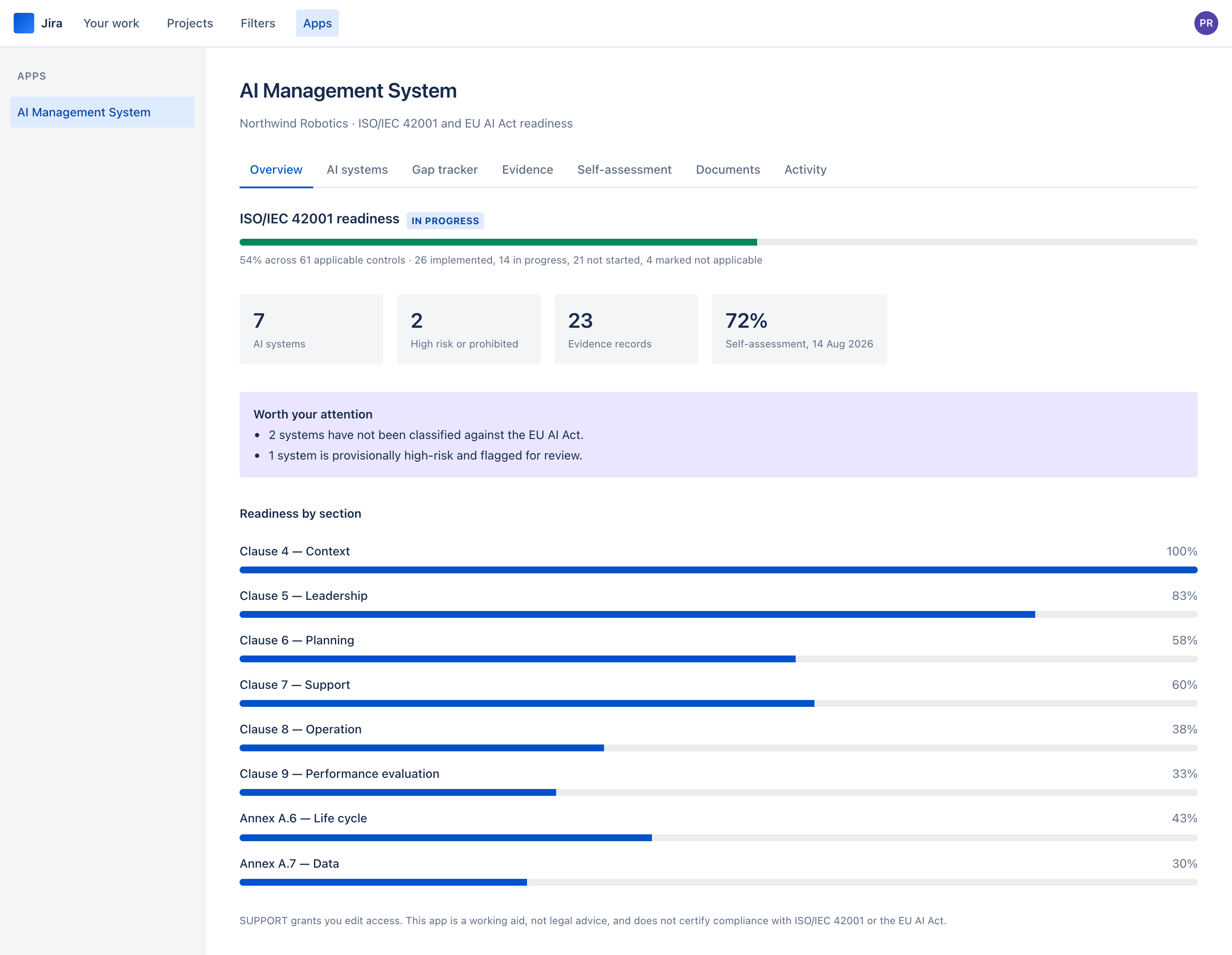
AIMS-in-a-Box keeps your AI system register, works out what the EU AI Act asks of each system, tracks the 65 ISO/IEC 42001 controls, and generates the documents an auditor asks for. It runs entirely inside Jira. Nothing leaves Atlassian.
The Marketplace listing is not published yet, so the button above writes to us instead.
The problem, stated plainly
You sell software to enterprises. Their procurement teams have started asking what AI you use and how you govern it, and the honest answer lives in three spreadsheets, a Confluence page somebody started in March, and one person's head.
The EU AI Act is in force
Obligations are phasing in through 2026 and 2027. Which ones apply depends on what each system does and whether you are its provider or its deployer — a question most teams have never written down system by system.
ISO/IEC 42001 is what buyers ask for
It is becoming the shorthand for "this vendor governs its AI". Certification is a project; knowing where you stand against its 65 controls should not be.
Consultants cost £10k–£25k
And they leave you with a document set that is out of date the week after they go. The work is ongoing; the tooling should be too.
What it does
Six things, numbered in the order you will use them. Each one feeds the next.
AI system register
Every AI system you build or use, with its purpose, its owner, your role — provider, deployer or both — and its lifecycle stage. Everything else reads from this list.
EU AI Act classification
A seven-question wizard resolves each system to prohibited, high, limited or minimal risk, and lists the obligations that follow, with the articles. Where the Act is ambiguous it takes the safer tier and flags the system for review.
ISO 42001 gap tracker
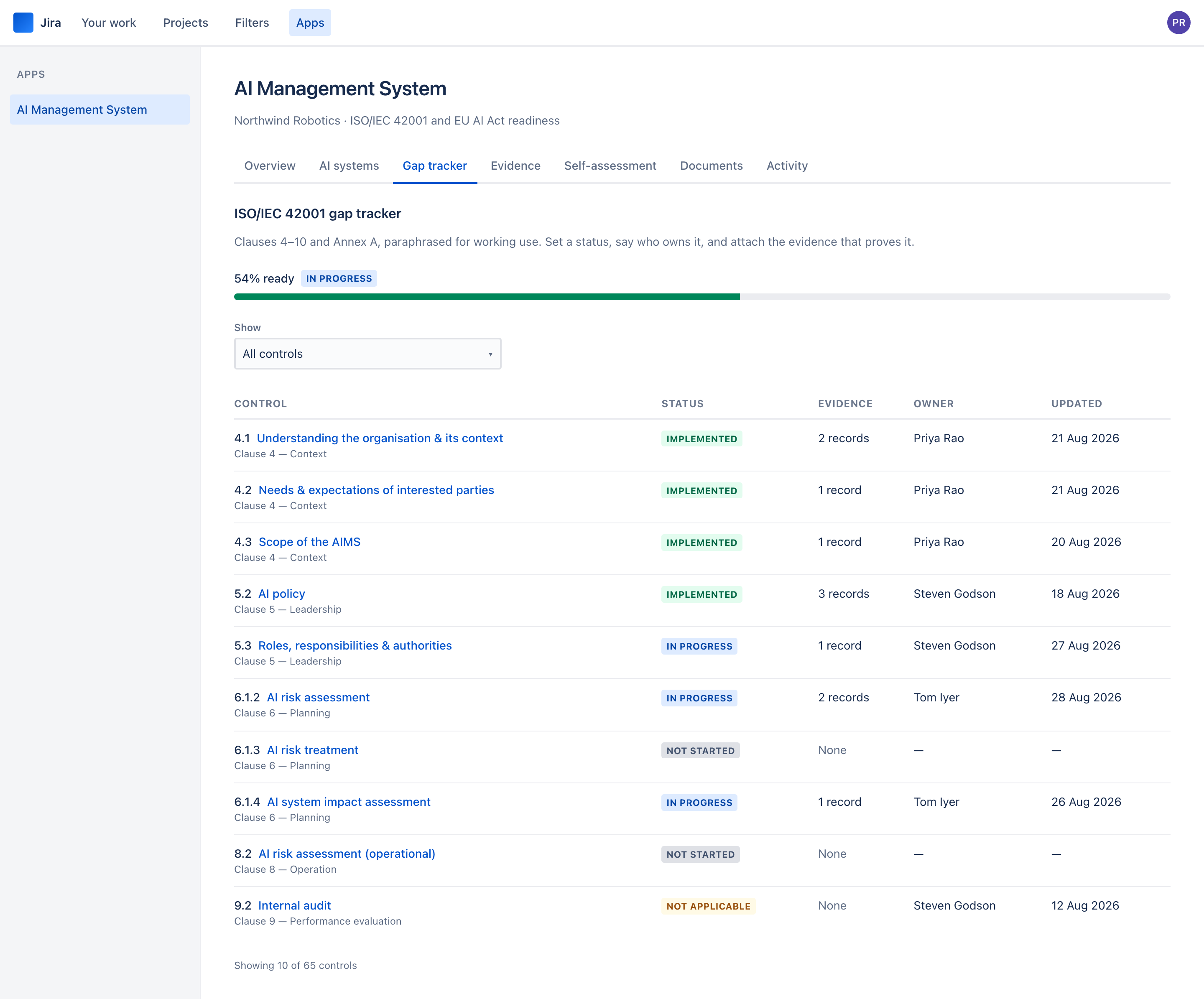
65 controls — 27 across clauses 4–10 and 38 from Annex A. Status, owner, notes, evidence, and an append-only history of who changed what.
Evidence register
What proves each control is in place and where it lives, linked to the controls it covers. The app records the reference; your documents stay where you already keep them.
Readiness self-assessment
18 questions across 6 weighted domains, in about five minutes. Every run is kept, so the movement is visible.
Audit-ready documents
6 documents generated from your own data. Each version is an immutable snapshot — print it, or save it as a PDF.
Zero external systems
This is the part a security reviewer cares about, so it is worth being exact. There is no database of ours, no payment provider, no mail provider, no analytics and no error reporting. The app's manifest declares no external permissions at all, and a test in the codebase asserts their absence.
Who does what
There is one AI Management System per Jira site, because an organisation has one AIMS — ISO/IEC 42001 is certified against a scope, not a department.
Jira administrators
Administer the AIMS. No separate owner list to keep in step with reality.
Contributors
Maintain the register, the controls and the evidence, and generate documents. They can also delete systems and evidence records.
Readers
See everything, change nothing. The right level for an auditor or a reviewer.
Nobody but a Jira administrator sees any AIMS content until a project administrator grants it, from a project they administer. The grant records which project it came from and who issued it — which is the question an auditor actually asks. The full model →
Start here
Four guides, written as end-to-end walkthroughs rather than feature lists.
Getting started
Install it, name your organisation, and give the right people access. About fifteen minutes, once.
Build the register and classify
List every AI system you build or use, then work out what the EU AI Act asks of each one.
Close the gaps
Work the 65 ISO/IEC 42001 controls: set a status, name an owner, attach the evidence that proves it.
Prove it
Score your readiness, generate the document pack, and hand an auditor something they can read.
See it on your own Jira site
The Marketplace listing is not published yet, so there is nothing to link to. Email us and we will tell you the day there is.