The operating rhythm
Governance fails when it is a project. What keeps an AI Management System true is a small amount of work happening on a schedule, plus knowing exactly what to do at the three moments that arrive without warning.
The recurring rhythm
Weekly · fifteen minutes
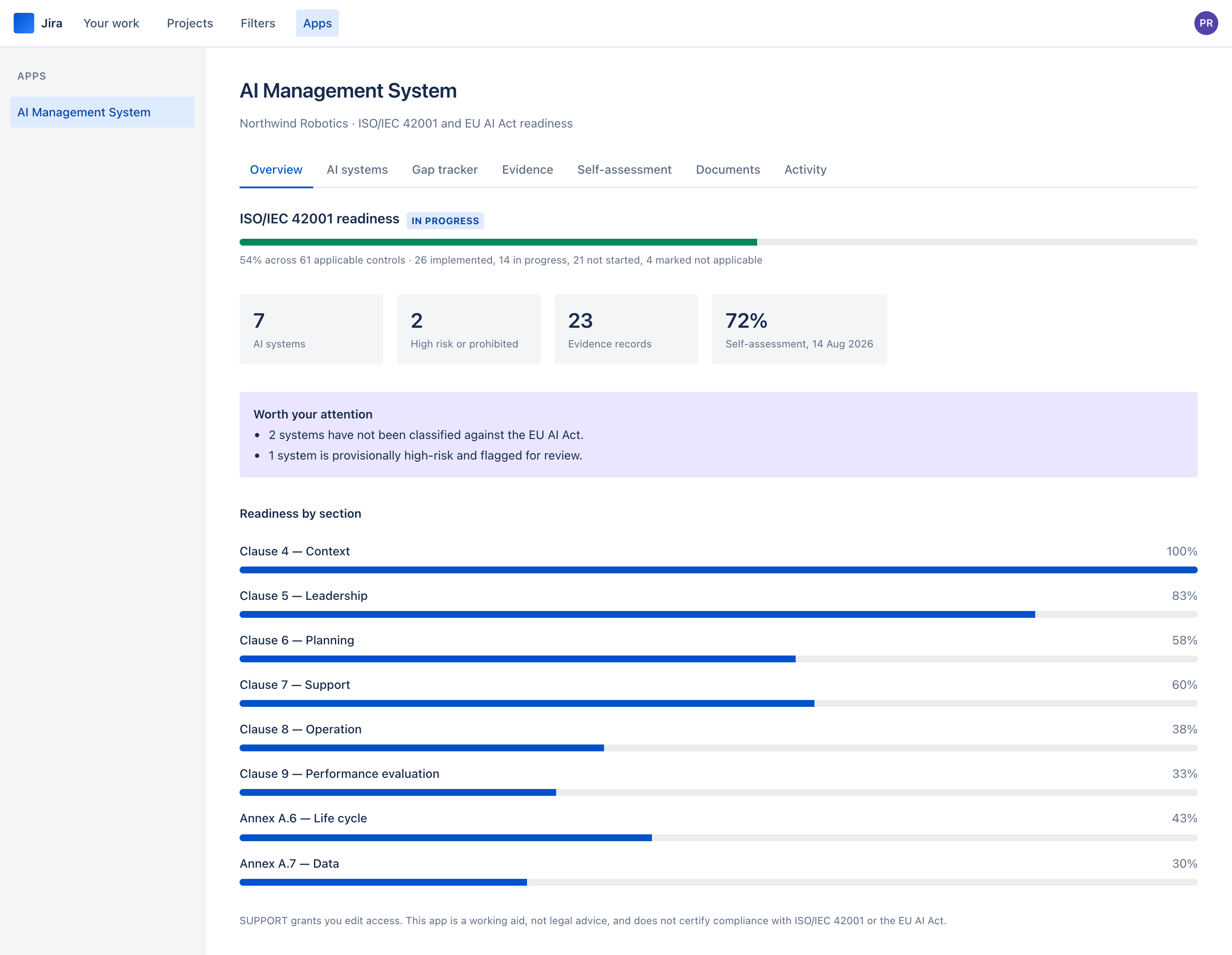
Whoever owns the AIMS opens the Overview and reads the "worth your attention" panel.
- Anything unclassified? Classify it, or chase the owner who can.
- Anything flagged for review? That is a system the engine could not place confidently. It needs a person.
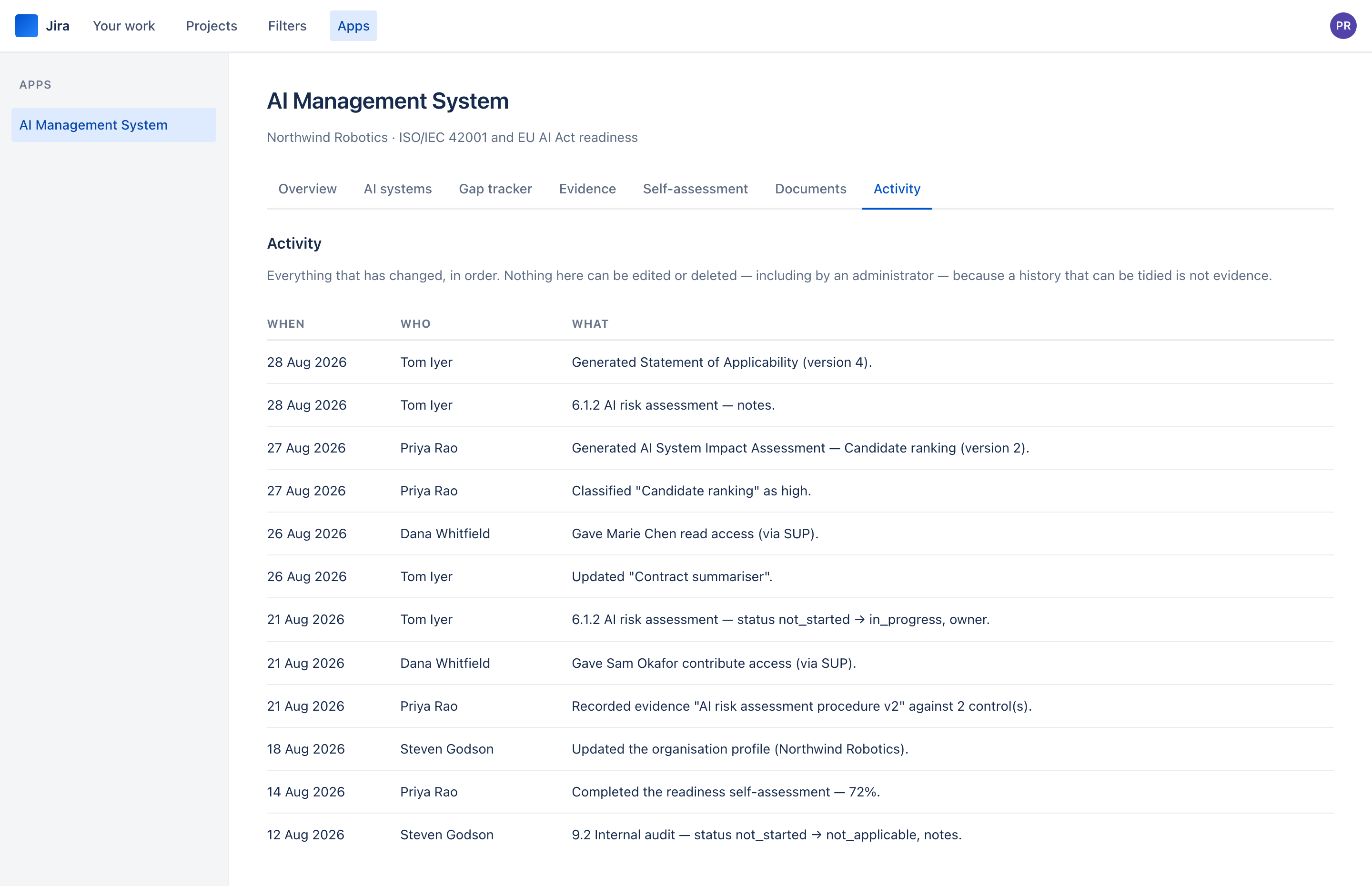
- Scan Activity for anything you did not expect — particularly access grants.
Monthly · an hour
- Work the gap tracker filtered to in progress. Which have actually moved? Which have been "in progress" for three months and are really not started?
- Check controls claiming implemented with no evidence attached. That list should be empty and never is.
- Ask each system owner whether anything about their system has changed enough to reclassify.
Quarterly · half a day
- Re-run the readiness self-assessment. Compare it with last quarter — the movement is the number you take to a board, not the absolute.
- Review evidence by last reviewed date. Anything older than a year needs somebody to confirm it is still true.
- Regenerate the Statement of Applicability and the AI System Register, so a current pack always exists.
- Review who has access. Withdraw anything that is no longer needed, and check for grants held by deactivated accounts.
Annually · a day
- Reclassify every system from scratch rather than reviewing last year's answers. It takes two minutes each and it catches drift that a review does not.
- Revisit the AIMS scope statement. Has what you cover changed?
- Regenerate the whole document set and get the AIMS Policy re-approved.
- Read the audit trail for the year. It is the only honest summary of what actually happened.
Moment one · somebody ships a new AI feature
The most common way an AI register goes stale. Make this the routine:
-
Register it before it launches
Add it at planned or in development. Name, one-line purpose, your role, an owner.
-
Classify it immediately
Two minutes, and it is the cheapest it will ever be. If it comes back high-risk you have found that out while the design can still change, which is worth a great deal more than finding out after launch.
-
Attach the obligations to the plan
If it is high risk, the classification result is a list of twelve or seven things with article numbers. That list belongs in the delivery plan, not in a compliance backlog nobody reads.
-
Move it to in use on launch day
And re-run the classification if anything changed between design and launch.
Moment two · a customer's security review asks about AI
Increasingly the reason SME vendors buy something like this: a deal is waiting on a questionnaire. What you can produce in an hour:
- AI System Register — answers "what AI do you use and what does it do?" in one document.
- Statement of Applicability — answers "do you follow a recognised standard?" better than a yes.
- Roles & Responsibilities — answers "who is accountable?"
- Your readiness score, with its date — answers "how mature is this?" without overclaiming.
Send the documents, and say plainly where you are. A vendor who says "we are at 54% against ISO 42001, here is our Statement of Applicability, here is what we are working on" is more credible than one who says they are compliant.
This app makes you audit-ready. It does not certify you, and nothing it generates says it does — every document carries a line saying so. Say "working towards", show the evidence, and let the pack do the rest.
Moment three · the audit
Whether it is a certification body, an internal audit, or a customer's assessor, the shape is the same.
-
Two weeks before: a clean pass
Regenerate every document. Read the Statement of Applicability yourself, line by line. Every "not applicable" needs a justification you would say out loud. Every "implemented" needs evidence attached.
-
Give the auditor Read only access
They see everything and change nothing. This is better than sending a pack: they can follow a control to its evidence to its history themselves, which is exactly the trail they are trying to establish.
-
Let the audit trail answer the hard question
Not "is this control in place?" but "how do I know it has been?" The history on each control shows who changed it and when, and it cannot be edited by anyone — including your own administrators.
-
Record findings as controls, not as a separate list
A finding is a control that is not where you said it was. Change the status, write the note, name the owner. Then the follow-up audit reads the same trail rather than a new spreadsheet.
Who does the work
In an SME this is usually three people, and it is worth naming them explicitly:
- An owner — often the CTO or a Head of Engineering. Accountable, does the weekly fifteen minutes, presents the quarterly number.
- One or two contributors — the people who actually classify systems and close controls. Usually an engineering lead and whoever holds security or data protection.
- Readers — everyone else who wants to see it: the CEO, the sales lead who answers security questionnaires, your auditor.
It does not need a full-time compliance function, and it does not work as a once-a-year scramble. Fifteen minutes a week from somebody accountable beats a fortnight in March.
See it on your own Jira site
The Marketplace listing is not published yet, so there is nothing to link to. Email us and we will tell you the day there is.